Guides
Can AI-Generated Jewelry Be Made Real?
Learn when an AI-generated jewelry concept can become a real wearable piece, what usually breaks in production, and how feasibility review protects quality, comfort, and delivery.
Yes, sometimes. But not automatically.
An AI-generated jewelry image can be a strong concept direction. It still needs feasibility review before it becomes real jewelry. A render can look beautiful while still failing at thickness, structure, comfort, stone security, or material behavior in real wear.
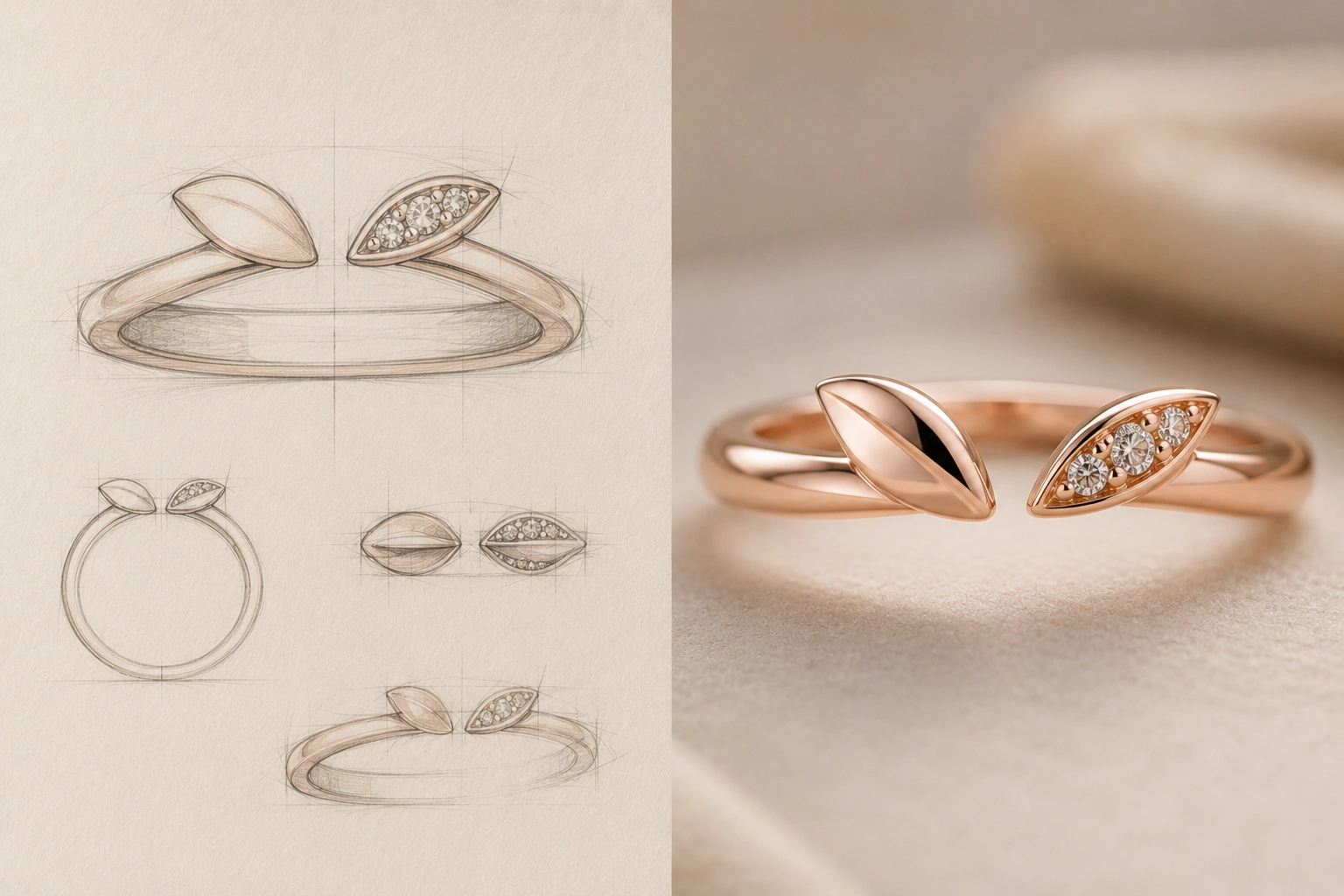
If you want to browse the full library first, start at the Story-Inspired Jewelry Guides hub.
Quick Summary
- AI images can be a useful start, but they are not production-ready by default.
- The biggest gap is physical reality: wearability, durability, and manufacturability.
- Most failures come from thin geometry, unstable settings, or over-complex details.
- A structured process converts concept into a reviewed path to quote, production, and delivery.
What Can Usually Be Made vs What Usually Fails
| Review area | Usually makeable with refinement | Usually fails without major redesign |
|---|---|---|
| Core shape | Clean, readable silhouettes with stable proportions | Extreme overhangs, fragile spikes, ultra-thin floating details |
| Thickness and structure | Balanced walls, practical joins, reinforced stress points | Decorative geometry that looks good in render but cannot survive daily wear |
| Stone setting | Standard setting logic with accessible adjustment room | Dense micro details that leave no safe seat, depth, or support for stones |
| Wearability | Smooth edges, body-aware scale, practical profile height | Sharp edges, oversized weight, unstable balance on body |
| Material behavior | Concepts aligned to metal constraints and finishing limits | Designs dependent on unrealistic polish, unsupported thinness, or impossible bends |
| Delivery risk | Clear checkpoints before production | Concept approved without feasibility checks or revision gates |
Why a Beautiful Render Can Still Fail in Real Jewelry
Render tools optimize for visual impact. Production optimizes for physical outcomes.
That mismatch is where risk appears:
- A thin line that reads elegantly on screen can bend or break.
- A dramatic setting can increase long-term stone loss risk.
- A large pendant may look balanced in isolation but feel heavy in daily wear.
- A shape that looks crisp in image form may require simplification for safe finishing.
If you need a step-by-step production lens, use Custom Jewelry Process. For durability standards, see Custom Jewelry Quality.
The Practical Path From AI Concept to Real Jewelry
The shortest safe route is:
- Concept direction: lock the emotional anchor and design intent.
- Feasibility review: check structure, thickness, scale, setting safety, comfort, and material fit.
- Revision pass: simplify weak geometry and align the concept with real constraints.
- Quote guidance: price based on material, complexity, stone requirements, and production effort.
- Production and QC: move into manufacturing, then quality-check before delivery.
This is why a service model matters. A generator gives images. A service carries accountability for what can actually be made.
Common Failure Points and How to Reduce Risk
Most avoidable failures are predictable:
- Too many symbolic details in one piece
- Concept approved before scale and comfort review
- Material chosen for color only, not long-term behavior
- No clear revision checkpoint before production
- Quote detached from design complexity
If you want a pre-order checklist, read Questions to Ask a Custom Jeweler Before You Order.
How Moonova Handles AI Concepts
Moonova uses AI for concepting, then runs human feasibility review before production. That review checks whether the concept can be worn, manufactured, and delivered with quality standards intact. The goal is not only visual inspiration. The goal is a realistic path from meaning to final jewelry.
If your main question is service positioning, read AI Jewelry Generator vs Custom Jewelry Service. If you want the full service page, see AI-Powered Custom Jewelry Design.
FAQ
Can I make jewelry directly from an AI-generated image without changes?
Sometimes, but many concepts still need refinement. A strong process checks structure, settings, scale, comfort, and material behavior before production starts.
Do I need technical jewelry drawings first?
No. You can start with plain-language intent and visual direction. Technical adjustments usually happen during feasibility review.
Will feasibility changes affect timeline or cost?
They can. Geometry, setting complexity, material choice, and production steps all influence both timing and quote range. That is why review should happen before final commitment.
How can I tell whether a concept is production-ready?
Production-ready concepts typically have stable structure, practical thickness, safe setting logic, wearable scale, and a clear material/finish path that can be executed reliably.
Continue Exploring Guides
Return to the guides hub, or continue with core decision guides on process and pricing.
Ready to turn your story into jewelry?
Start generating your design on Moonova, then refine it with human review for a piece that is truly yours.